Skip to content
Pratik Sharma

Software engineer · Full-stack developer

Building software that solves real problems.

I’m a software engineer building enterprise SaaS applications, scalable backend systems and AI-powered products. I enjoy turning complex engineering challenges into reliable, practical solutions.

Currently building at Simplify3x.

  • 01

    Full-stack engineering

    Building complete applications and product experiences.

  • 02

    Backend systems

    Designing APIs, integrations and reliable application workflows.

  • 03

    AI-powered applications

    Integrating modern AI capabilities into practical products.

01focus

Engineering beyond the basics.

Four areas where most of my work has landed so far.

  • 01

    Enterprise SaaS

    Features and workflows inside a QA platform used by test teams — role-based access, impact tracing, and module-level permissions enforced on every request.

  • 02

    Backend engineering

    Layered REST APIs, background jobs, queue-driven pipelines and asynchronous workflows that keep long-running work off the request path.

  • 03

    Integrations

    Two-way Jira synchronisation, Azure connectivity, Gmail API sending and OAuth 2.0 flows — the unglamorous work of making two systems agree.

  • 04

    AI and LLMs

    Writing assistants built on hosted LLMs, with the prompt design, fallbacks and rate limits that decide whether a feature is usable or just a demo.

02selected work

Building products. Solving engineering problems.

Products and engineering projects spanning full-stack development, backend architecture, integrations and AI-powered experiences.

Featured project2026 · live

Beacon AI

AI-powered email automation platform

A multi-tenant email automation platform that helps people run personalised cold email campaigns from their own Gmail account.
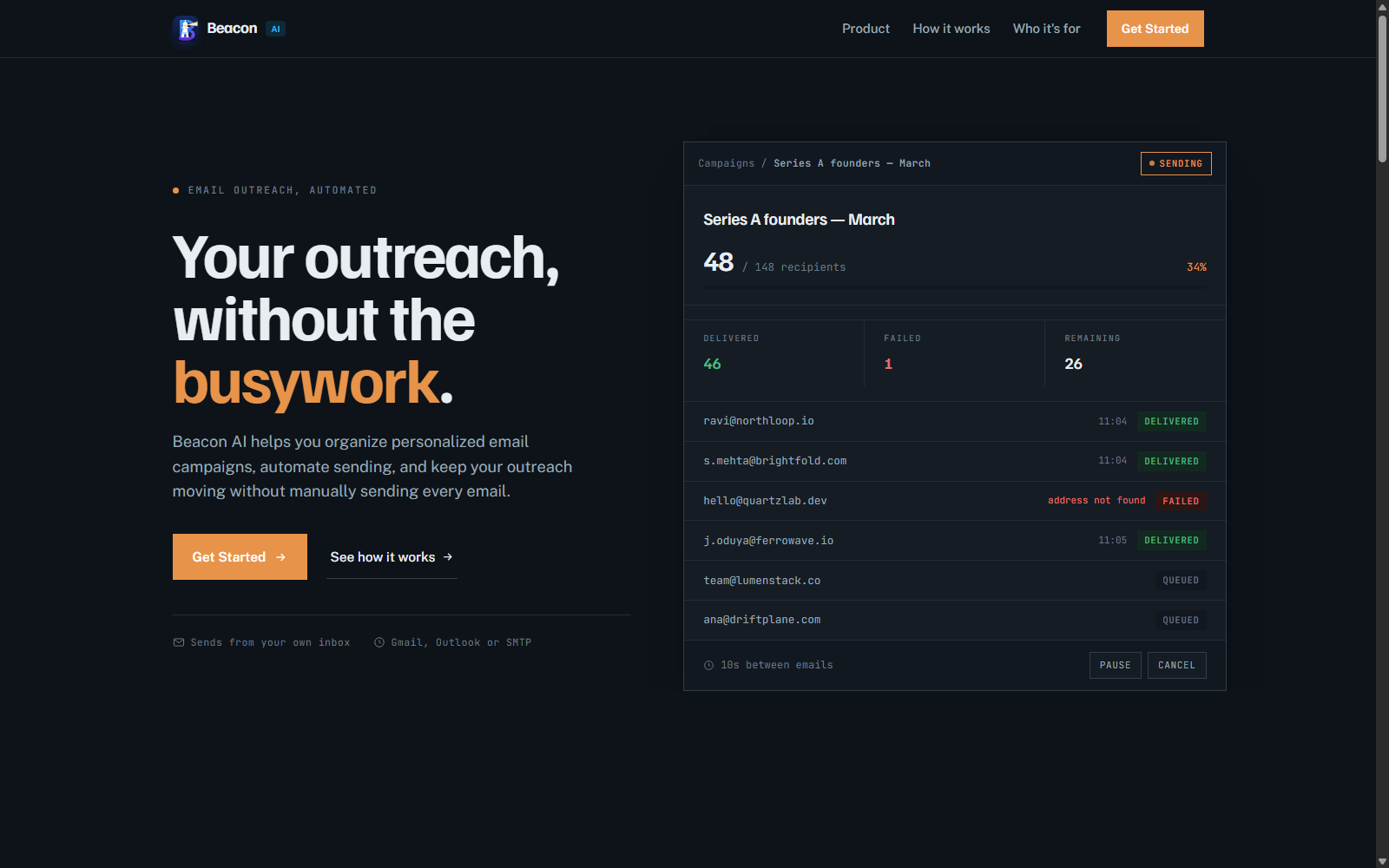
beacon.heypratikk.com — screenshot
beacon.heypratikk.com

Beacon AI pairs campaign automation with AI-assisted writing. People connect their own Gmail, import a list, and send personalised sequences that go out from their address rather than a shared relay — so replies land in their inbox and their own domain carries the sending reputation.

How it is built

01

Multi-tenant authentication

  • Google OAuth 2.0 sign-in
  • Sends through each user's own Gmail account via the Gmail API
  • User-scoped data, so one tenant's campaigns are never reachable from another
  • JWT authentication on every protected endpoint
02

Background email processing

  • Asynchronous send pipeline on BullMQ and Redis
  • Resumable workers, so a restart mid-campaign continues rather than starting over
  • Long-running campaigns kept off the request path entirely
03

Real-time campaign monitoring

  • Live progress streamed over Socket.IO
  • Progress survives navigation and refresh, because the server owns the state
04

AI writing assistant

  • Groq and Qwen3-32B integration
  • Generates a complete email from a one-line brief
  • Suggests subject lines
  • Rewrites an existing draft
05

Backend architecture

  • Layered Express API: routes, controllers, services, models
  • MongoDB with Mongoose
  • Centralised error handling and one consistent response envelope

architecture

  1. Frontend

    Angular + TypeScript

  2. Backend API

    Node.js + Express + JWT

  3. Database

    MongoDB + Mongoose

Background email processing

  1. Express API
  2. BullMQ
  3. Redis
  4. Worker
  5. Gmail API

Real-time updates

  1. Worker
  2. Socket.IO
  3. Angular

AI integration

  1. Angular
  2. Express API
  3. Groq / Qwen3-32B

Built with

  • Angular/
  • TypeScript/
  • Node.js/
  • Express.js/
  • MongoDB/
  • Redis/
  • BullMQ/
  • Socket.IO/
  • Gmail API/
  • Google OAuth 2.0/
  • Groq / Qwen3-32B

2024 · source available

Skills Up

Full-stack e-learning platform

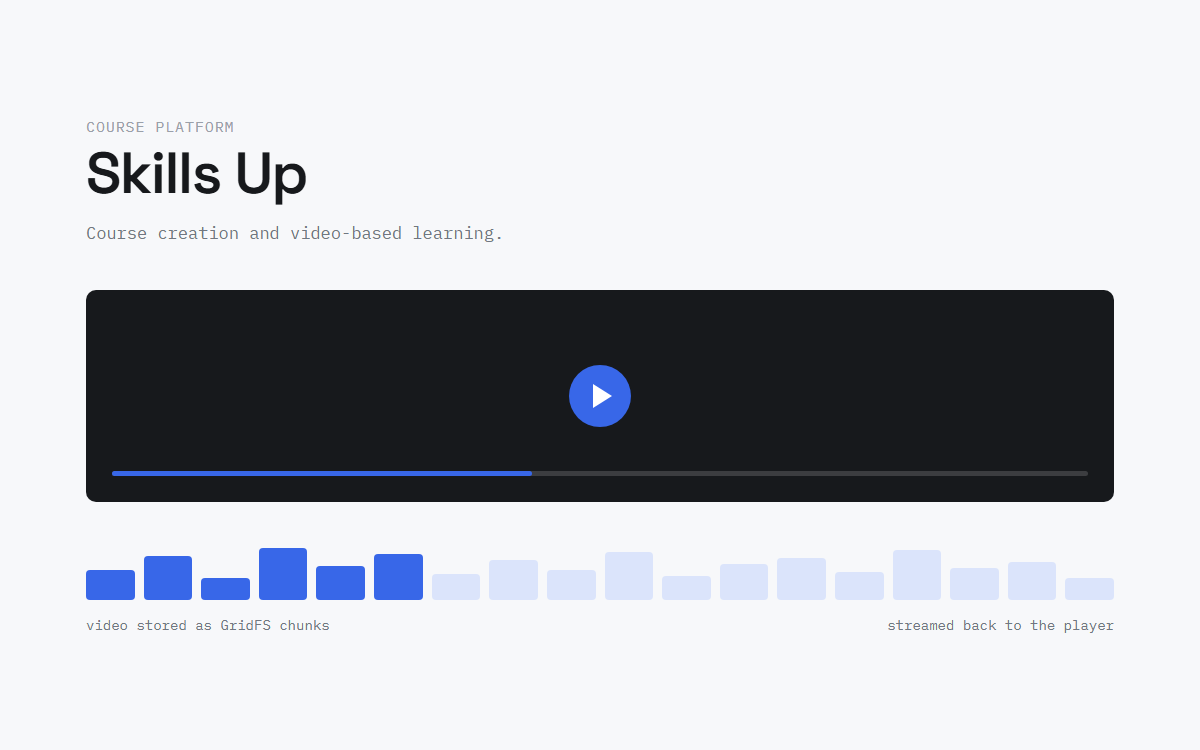
A full-stack e-learning platform built to support course creation and video-based learning.

Instructors create courses and upload lesson video; students browse the catalogue and watch lessons back in the browser. Video is the awkward part of a platform like this — files are large, and a document database is not built to hold them whole — so storage goes through GridFS rather than the filesystem.

01

Course management

  • Full-stack e-learning application
  • Course creation workflows
02

Video storage

  • MongoDB GridFS for storing and retrieving video content
03

Video delivery

  • Video streaming to support in-browser playback
Course platform — illustration — screenshot
Course platform — illustration

Built with

  • MongoDB/
  • Express.js/
  • Angular/
  • Node.js/
  • GridFS

architecture

  1. Frontend

    Angular

  2. Backend API

    Node.js + Express

  3. Storage

    MongoDB + GridFS

Video delivery

  1. Upload
  2. GridFS
  3. Stream
  4. Player
03history

Where I’ve been building.

Sep 2025 — Present

Associate Software Engineer

Simplify3x — SimplifyQA, Bengaluru

Permissions, traceability, and the integration layer that keeps the QA platform in step with the tools teams already use.

  • Architected dual-path Word export for manual test cases on a BullMQ and Redis queue with RabbitMQ email delivery, so large suites export without the request timing out
  • Implemented project-level role-based access control across User Stories, Test Cases, Suites and Test Data, enforcing create, view, update and delete privileges on every API request
  • Designed the Impact Analysis module, tracing Epics, Features, Stories and Test Cases through dynamic filtering
  • Implemented Jira subproject mapping, letting one SQA project synchronise across several Jira projects
  • Extended Jira synchronisation to attachments, comments, linked issues and project configuration
  • Added auto-provisioning of custom field options during Jira-to-SQA sync, creating missing values for state, priority, severity and custom list fields so mismatched configuration stops breaking the sync
  • Worked on Azure integration for connectivity with Azure-based project workflows
  • Angular
  • Node.js
  • TypeScript
  • MongoDB
  • Redis
  • BullMQ
  • RabbitMQ
  • Jira API
  • Azure

Feb 2025 — Aug 2025

Software Engineer Intern

Simplify3x — SimplifyQA, Bengaluru

Joined on the integration layer and the parts of the UI costing users time.

  • Implemented Jira error handling and field-level validation, so users could see and resolve synchronisation errors in the product rather than in a log
  • Fixed UI defects across requirement management, execution plans and dashboards
  • Angular
  • TypeScript
  • Jira API

Nov 2020 — 2024

B.E. Computer Science

Acharya Institute of Technology, Bengaluru

04case notes

Not just building features. Solving problems.

Four things that were harder than they looked, and what the fix actually was.

SimplifyQA

Exports that timed out on large test suites

What was wrong

Generating a Word export of a large manual test suite ran inside the HTTP request. Past a certain size the request timed out and the user got an error instead of a document.

Why it was hard

Making it faster would only move the limit. The work genuinely takes a while, so it had to stop being something a request waits for.

The approach

Moved generation onto a BullMQ and Redis queue with a dual-path design: small exports still return inline, large ones go to the queue and arrive by email through RabbitMQ. The user gets an immediate answer either way.

Where it landed

Large suites export without the request timing out.

SimplifyQA

Jira syncs failing on configuration nobody controlled

What was wrong

Synchronising from Jira failed whenever a Jira project used a value that didn't exist on the SQA side — a priority, a severity, an option in a custom list field.

Why it was hard

The mismatch isn't a bug in either system. Two tools owned by different teams drift apart, and the sync sits in the middle of that drift.

The approach

Auto-provision the missing options during sync. When a value arrives that SQA doesn't recognise, create it rather than reject the record — for state, priority, severity, and custom list, radio and checkbox fields.

Where it landed

Mismatched field configuration stopped being a cause of sync failure.

Beacon AI

Campaign progress that disappeared on refresh

What was wrong

A send runs for minutes. If progress lives in the browser, refreshing loses it, and the user can't tell whether the campaign is still running or died.

Why it was hard

Progress has to be owned by the server and re-derivable at any moment, not accumulated client-side.

The approach

Put the send on a BullMQ worker that keeps its cursor in Redis, and stream progress over Socket.IO. The client subscribes to state rather than counting it, so a refresh reconnects and catches up.

Where it landed

Progress survives navigation and refresh, and a restart mid-campaign resumes rather than starting over.

SimplifyQA

One permission check, every endpoint

What was wrong

Role-based access had to apply across User Stories, Test Cases, Suites and Test Data, with separate create, view, update and delete privileges per project.

Why it was hard

Permission logic scattered through controllers is how authorisation bugs happen — the endpoint someone forgets is the one that leaks.

The approach

Enforced the check on every API request rather than per feature, so a new endpoint is covered by default instead of by memory.

Where it landed

Per-action privileges apply consistently across all four modules.

05tooling

Tools I use to build things.

Everything here appears somewhere in the work above.

Languages
  • JavaScript
  • TypeScript
  • Java
Frontend
  • Angular
  • React
  • HTML
  • CSS
  • Bootstrap
Backend and APIs
  • Node.js
  • Express
  • REST
  • Webhooks
  • Socket.IO
Queues and messaging
  • BullMQ
  • Redis
  • RabbitMQ
Databases
  • MongoDB
  • Redis
  • GridFS
Integrations
  • Jira
  • Azure
  • Gmail API
  • Google OAuth 2.0
AI and LLM
  • LLM integration
  • Prompt design
  • Groq
Tools
  • Git
  • GitLab
  • Jira
  • Postman
  • Docker
06about

A little about the person behind the code.

I'm a software engineer in Bengaluru, currently at Simplify3x working on a QA platform. Most of what I do sits behind the interface: APIs, background jobs, permissions, and the integration layer that keeps our product in step with Jira and Azure.

I ended up in backend work because that's where the interesting failures are. A button either works or it doesn't. A sync between two systems owned by different teams fails in ways nobody designed, and fixing it properly means understanding both sides.

Outside work I build things end to end. Beacon AI started as a question — could cold outreach run from your own mailbox instead of a shared relay — and turned into a multi-tenant product with a queue-backed send pipeline and an LLM writing assistant. Building the whole thing, deployment included, is how I learn the parts a feature ticket never exposes.

Also on LeetCode, when a problem needs sleeping on.

Always learning. Always building.

What I’m reading about and poking at right now.

  • LLM applications beyond the chat box

    Where a model is genuinely the right tool and where a function call would have done. Most of the work turns out to be prompt design, fallbacks and cost.

  • Multi-tenant architecture

    Scoping every query to a tenant by construction rather than by remembering. The shape of the data model decides whether isolation actually holds.

  • Queue-driven systems

    Resumability, idempotency, and what a worker should do when it wakes up halfway through a job it doesn't remember starting.

  • Deployment and infrastructure

    Running my own things on a VPS — Docker, a reverse proxy, certificates, and the parts that only teach you anything when they break.

Have an interesting problem? Let’s build something.

I’m always interested in talking about engineering challenges, product ideas, and opportunities to build something that lasts longer than a sprint.